



What is 3I/ATLAS?

3I/ATLAS is making global headlines as the newest—and weirdest—visitor to cruise through our solar system. Officially named C/2025 N1 (ATLAS), it’s the third interstellar object ever discovered, meaning it comes from another star system, just like the famous ‘Oumuamua and 2I/Borisov.
Discovered on July 1, 2025, by Hawaii’s ATLAS survey, 3I/ATLAS is a comet, but the intrigue is off the charts:
- Its massive speed (over 60 km/s).
- Its strange, almost perfectly ecliptic-aligned, retrograde trajectory (unusually flat—just a 5° tilt).
- An unexpected lack of a typical comet tail even after close approach to the Sun.
Why is it Such a Big Deal?
1. It’s Not from Around Here.
3I/ATLAS shot in from the direction opposite the solar apex (the sun’s movement through the galaxy), which surprised scientists expecting more visitors from the apex direction. Its arrival path makes it a rarity among cosmic wanderers.
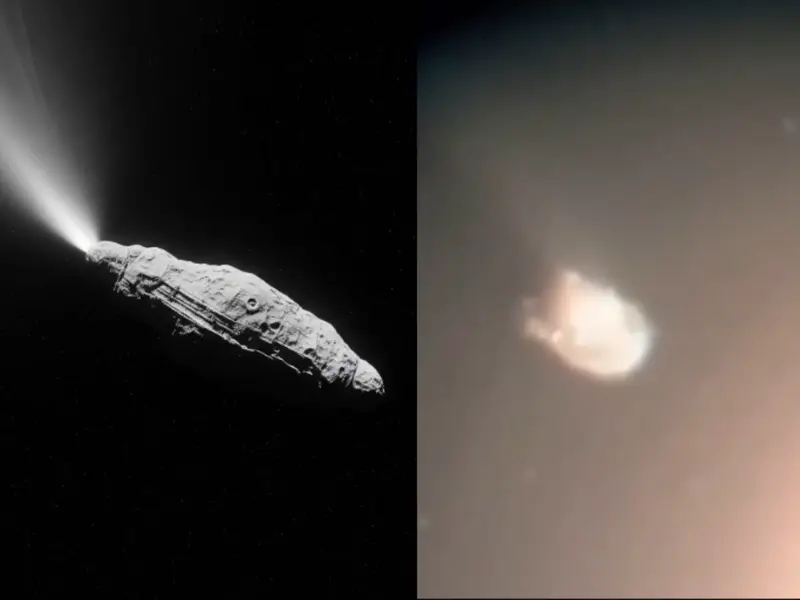
2. No Tail—Conspiracy or Just Weird Science?
After zooming past the Sun, researchers expected 3I/ATLAS to sprout a classic glowing tail of gas and dust. It didn’t. This has:
- Intensified debates about its true nature—could it be an asteroid or even something artificial?
- Fueled viral conspiracy theories (helped by a leaked NASA image showing “structure”).
3. Composition is Out-of-this-World—Literally.
Spectroscopy shows a high content of carbon dioxide and a blue-to-green hue, with a dust coma and only a faint (if any) tail. That’s weird even by interstellar standards, and has driven theories ranging from it being a radically altered comet bombarded by galactic rays to speculations about artificial (alien) tech.
The “Alien Probe” Buzz
Harvard’s Avi Loeb, famous for ‘Oumuamua’s “alien probe” hypothesis, has stoked discussions here again:
- No clear cometary outgassing or dust tail.
- High-speed, near-ecliptic entry—almost like targeting key planets for a flyby.
- Suggestion: Could 3I/ATLAS be a remnant of alien technology or something propelled on purpose?
- Most mainstream astronomers say “absolutely not”—but the wild ride for science (and the internet) continues.
How Big is 3I/ATLAS?
- Estimated nucleus: “Manhattan-sized” (potentially a few kilometers across).
- Coma (dust cloud): Detected, but faint and unusual for its orbit and activity level.
- Tail: Barely visible, only through powerful research telescopes.
Is 3I/ATLAS Dangerous?
No.
- Its trajectory takes it nowhere near Earth (closest approach: Mars, Venus, and Jupiter, but not us).
- Despite wild claims about extinction-level impacts, NASA and other institutions stress that it poses no threat to life or our planet.
Can You See It?
- If you own a large telescope (8-inch aperture or more), it’s visible in the early morning eastern sky, November–December 2025.
- It is NOT visible to the naked eye; professional astronomers need high-end gear to track it.
What’s Next?
- NASA and world observatories are tracking 3I/ATLAS with Hubble, James Webb, and ground-based telescopes.
- Expect more data—and maybe more surprises—especially on its way out of the solar system later this year.
Quick Facts Table
| Attribute | Details |
|---|---|
| Official Name | 3I/ATLAS (C/2025 N1) |
| Type | Interstellar comet (possibly anomalous) |
| Discovery | July 1, 2025 (ATLAS, Hawaii) |
| Closest Approach | Passed Mars, then outward—NO threat to Earth |
| Size | Possibly a few km (Manhattan-sized) |
| Visible Tail? | None or faint (unlike typical comets) |
| Public Buzz | Alien probe? Oddities and online frenzy |
| Visibility | Telescope only, Nov–Dec 2025 |
| Real Risk? | None; safe flyby—just a “tourist” |
Why 3I/ATLAS is the Year’s Most Intriguing Mystery
Our solar system hasn’t seen a cosmic enigma like this in years. 3I/ATLAS is rattling scientists, captivating sky-watchers, and sparking imaginations everywhere. From doomsday rumors to the hunt for alien tech, 3I/ATLAS is a story you’ll be hearing about well into 2026.
FAQs
3I/ATLAS is the third confirmed interstellar object discovered passing through our solar system, likely a comet with an origin far outside the Sun’s neighborhood.
It was detected on July 1, 2025, by the ATLAS survey network in Hawaii, which specializes in spotting fast-moving objects and potential threats to Earth.
Its hyperbolic trajectory means it’s moving too fast to be gravitationally bound to the Sun, and analysis shows it comes from beyond our solar system.
No. Its closest approach was not to Earth, and astronomers confirm it poses no threat of impact now or in the future.
3I/ATLAS’s unusual characteristics (lack of bright tail, odd trajectory) have led some scientists and enthusiasts to speculate about non-natural origins, though the majority scientific consensus is that it’s a natural comet or asteroid.
Researchers believe its composition or cosmic ray exposure may be different from typical solar system comets, resulting in weak or unusual outgassing and a faint or missing tail.
Only with large, professional-grade telescopes. It is not visible to the naked eye.
Yes, as surveys and technology improve, astronomers expect to find more interstellar visitors in the coming years.
